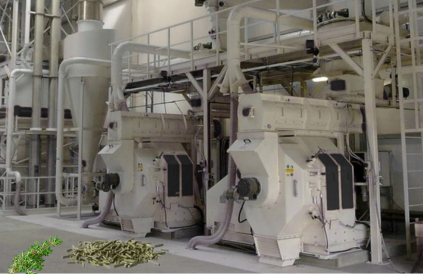
Alfa alfa pellet production process
Alfalfa is a highly valued forage crop, well known for its rich protein content, high fiber levels, and overall nutritional quality. It is widely used in feeding livestock such as cattle, horses, and sheep. However, in its natural form—whether fresh or dried as hay—alfalfa can be bulky, inconsistent in quality, and somewhat difficult to store and transport efficiently.
Processing alfalfa into pellets helps overcome these limitations. By compressing the plant material into a uniform, dense form, pelleting makes it easier to handle, reduces variability in nutritional content, and significantly improves storage and transportation efficiency. As a result, pelletized alfalfa becomes a more practical and reliable feed option for modern farming operations.
Alfalfa Pellet Production Process and Machine
The process of converting alfalfa into pellets involves a series of carefully controlled steps, each designed to preserve its nutritional value while improving its physical characteristics. In modern pelleting plants, efficiency and product quality rely heavily on the integration and reliability of specialized machinery. Companies such as La Meccanica provide complete, well-engineered lines capable of managing every stage of the process with precision.
The process begins with harvesting the alfalfa at the optimal stage of growth—typically at early bloom—when its nutritional content is at its highest. After harvesting, the material must be dried to reduce its moisture content to a safe and stable level. This can be achieved either naturally in the field or through mechanical systems, depending on production scale and weather conditions. In industrial settings, drying is carried out using a Dryer, which ensures uniform moisture reduction by exposing the alfalfa to controlled heat and airflow. This step is essential for stabilizing the material and preparing it for further processing without compromising its quality.
Once properly dried, the alfalfa is ground into a fine and uniform material. This is achieved using a La Meccanica Hammer Mill, which reduces the material to a consistent particle size. Uniform grinding is crucial, as it improves compressibility and ensures that the final pellets have a consistent structure and durability.
The ground material then undergoes conditioning. In the La Meccanica Conditioner, steam is added in a controlled manner to increase both temperature and moisture. This process softens the plant fibers and activates natural binding agents within the alfalfa, significantly improving pellet formation and the efficiency of the pressing stage.
At the heart of the process is the La Meccanica Pellet Mill. Here, the conditioned material is forced through a die by rollers, forming dense, uniform pellets. This machine plays a critical role, as it directly determines the shape, density, and overall quality of the final product.
Freshly produced pellets are still hot and slightly soft, necessitating a stabilization phase. This is achieved using a Counterflow Cooler, which reduces both temperature and residual moisture. By passing air in the opposite direction to the flow of pellets, the system ensures gradual and even cooling, preventing cracks and enhancing pellet durability.
Finally, the pellets are refined in a Screening Machine, where fines and broken particles are removed. This final step ensures a clean, uniform product, while any separated material can be efficiently recycled back into the production process.
Processing alfalfa into pellets is a highly efficient way to enhance its value as animal feed. Through a series of mechanical and thermal steps—harvesting, drying, grinding, conditioning, and pelletizing—raw forage is transformed into a durable, nutrient-rich product. The machinery involved ensures consistency and scalability, making pellet production suitable for both small farms and large commercial operations.
Ultimately, alfalfa pellets offer significant advantages in storage, handling, nutrition, and feeding efficiency, making them an essential component of modern livestock management.